Ensuring safe operations

Our Mission
The Air Rescue Association of Canada (ARAC) is a dedicated, emerging volunteer-led organization committed to strengthening Canada's national search and rescue (SAR) framework.
Our mission is to establish and sustain a unified network of highly trained, professional, specialized helicopter rescue teams — enhancing critical public safety capabilities across the nation.
Respecting the established relationships between regulators, air carriers and emergency response organizations outlined in CASS, ARAC works collaboratively with member teams and their aviation partners to develop operating guidelines, best practices and minimum performance standards for aerial rescue operations.
These standards help member teams meet regulatory requirements while promoting the safe and consistent deployment of qualified personnel on missions requiring specialized aerial rescue techniques.
What motivates us

Welcome to Our World
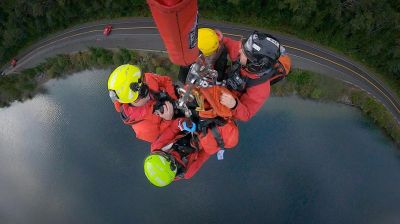
Class D rescue dramatically speeds up extraction and reduces the time rescuers and subjects are exposed to dangerous conditions. These incidents often require rapid transport to medical care from places where landing a helicopter simply isn't possible.
ARAC standardizes training, operating guidelines and quality assurance for Class D external load rescues — the fixed-line (longline/HETS/HEC) and hoist techniques that let search and rescue crews extract people from challenging terrain. ARAC also provides training standards for night vision (NVIS) rescues and other specialty operations.
SettinG the standard
Strategic Priorities
- Ensure personnel can operate safely and effectively during helicopter-based SAR missions.
- Ensure member teams maintain compliance with CARs, CASS, provincial policy, and industry best practices.
- Establish consistent procedures and standardized competency across all member Class D and specialty rescue teams.
- Grow a nationally recognized Class D standard through collaboration with air carriers, HAC, and government.
our role in emergency response

Overview of Initiatives
ARAC is proactively developing initiatives aligned with federal safety objectives and national preparedness strategies through the following efforts.
National Standardization in Training
- A federated training program anchored by the ARAC Helicopter Operations Training Program (HOTP) Levels 1–3, providing initial, recurrent and continuation training for Class D rescue technicians, including crew resource management (CRM) and team leader development.
Advanced Digital Learning and Compliance Platform
- A digital learning management system (DATS) serving as a central repository for training, compliance tracking and operational data.
Federally-Aligned Operating Guidelines
- Standardized guidelines covering air carrier–SAR team MOUs, training protocols, CRM implementation and operational manuals.
Transparent Quality Assurance and Regulatory Compliance
- Independent audits, peer reviews and digital reporting verifying member teams' compliance with CARs, Commercial Air Service Standards, and industry best practices.
Strategic Partnerships and Collective Advocacy
- Building relationships with member SAR teams, air carriers and federal regulatory bodies to provide a unified voice for specialized helicopter rescue.
Reinforcing Canada's emergency response infrastructure
- ARAC represents a proactive, collaborative approach to reinforcing Canada's emergency response infrastructure — a scalable, transparent, federally-aligned solution to critical aerial rescue needs, bridging gaps in specialized SAR support so that Canada's remote and challenging environments are met with the highest standard of rescue readiness.
Why Work With Us
ARAC is incorporated as a not-for-profit society under British Columbia's Societies Act and governed by a board responsible for the overall stewardship and management of the Society.
ARAC proudly builds upon a significant legacy that first began in 1991. Today, we are revitalizing ARAC to meet the evolving needs of our aerial rescue community and to profoundly strengthen national capabilities across Canada.
Our association benefits organizations by contributing to safer, more standardized and effective rescue operations across the country.